
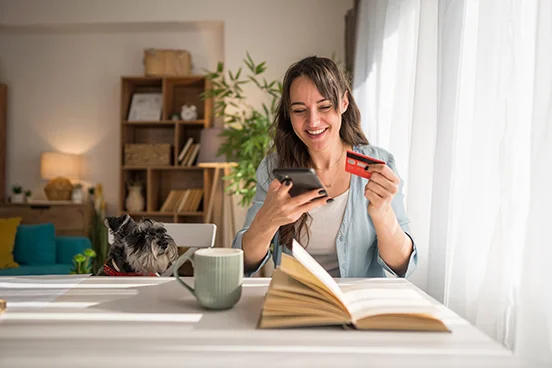
Fight fraud with these tips and tools.
We all love the convenience of shopping, socializing, and managing money online. Here's what to consider to make sure you're protecting your identity and accounts.
Identity Theft and Fraud
Your personal information is highly valuable. Make sure you guard it closely. Keep these tips in mind as you manage your accounts online.
Sign up for eStatements
through Online Banking to help prevent mail fraud.
Review your account activity
regularly to detect fraud earlier.
Shred any documents
with personal information before discarding.
Never share your personal information
with anybody who contacts you online or by phone.
Password Safety
Passwords unlock all your accounts and information. So, keep them as secure as possible.
Keep your password private. Don’t share your password with anyone under any circumstance!
Even if you trust someone, you should never give out your password. Your communications could be intercepted, the other person may write your password down or save it somewhere, or the other person’s computer may be infected with malware.Always use long, complex passwords.
Passwords that can be found in a dictionary can be cracked in seconds. Hackers like to use password cracking programs to guess your password by trying every combination of numbers, letters, and special characters. To guard against these password-cracking programs, use long & strong passwords — the longer the password, the harder it is to crack. Make sure it always contains a combination of upper and lowercase letters, numbers, and special characters like “&” and “%”. If you're not using multi-factor authentication (MFA), use a password length of 16 characters or more.Create passwords that can’t be easily guessed.
If your password can be easily guessed, it weakens security and might lead to a costly breach. Don’t choose passwords with birthdays, children’s names, anniversary, pets' names, hometown, or favorite sports teams that could all be easily found from social media accounts or other sources. Attackers search the social media websites for personal details like these and try them as passwords.Use a sentence or passphrase.
Think of a sentence or phrase that is easy to remember but hard for someone to guess, or turn your favorite quote into an acronym. Longer is stronger, so opt for passphrases rather than passwords.Consider using a password manager to keep track of your passwords.
Do not write your passwords on sticky notes that can be seen by others, or store them on your computer in clear text. Instead, use a secure password manager — an encrypted vault for storing passwords that is protected by a master password. Most password managers also can generate passwords for you. Make sure to use a very long and complex password for your master password.Do not use simple adjacent keyboard combinations.
Also known as keyboard progressions, these are easy to crack. Examples of these include, “qwerty”, “12345”, and “1qaz”.Change your password immediately if you suspect it may have been compromised.
If you notice strange activity on your account, immediately change that account’s password, and never use the same password for multiple accounts.MFA all the way.
Passwords alone cannot always provide sufficient protection. Use two-factor authentication for sensitive accounts. Multi-factor authentication is a special type of security that involves two separate types and stages of authentication. Usually, two-factor authentication uses something you “have” along with something you “know.” ATMs use multi-factor authentication by requesting your debit card and your PIN. Many online accounts require two factors: a password and a verification of your identity with your phone or another device with a one-time passcode. Other forms of multi-factor security authentication might include a token or a removable media device, such as a USB drive.Do not re-use important passwords. Use unique passwords for each account.
If you use the same password for multiple accounts, you increase your overall risk. The breach of a single account could potentially lead to the breach of all of your accounts. When a hacker knows your username and password on one service, the hacker will try the same login information on other services. To thwart these types of attacks, use unique passwords for every account you have and change them often. Email addresses, personal banking, your Amazon account, cable and internet services, mobile devices, personal computers, and all your other online shopping accounts should all have separate passwords.Public computers may be infected with malware or have other security issues. Never enter your username and password on an untrusted computer.
Public computers, such as those at hotel business centers, libraries or Internet kiosks, may not be appropriately secured. They could be infected with malware, which could potentially steal your password. You could also forget to log out, leaving your account vulnerable to intrusion. To avoid this, don’t log in to your account on a public computer. When traveling, always use a secure Internet connection.